
By Stephanie Johnson
Published January 23, 2026
When sellers ask me when is the best time to list their home for sale, it can be tempting to look at only a few months of comparable sales to determine how and when to move forward. But when you zoom out and study five, ten, or even twenty years of housing data, a much clearer — and more reliable — pattern emerges.
Across both Sonoma County and San Francisco, the real estate market follows remarkably consistent seasonal trends. While prices and interest rates may change year to year, buyer behavior and inventory cycles remain largely the same.
Understanding these patterns — not just last year’s numbers — is what allows sellers to time their listings strategically.
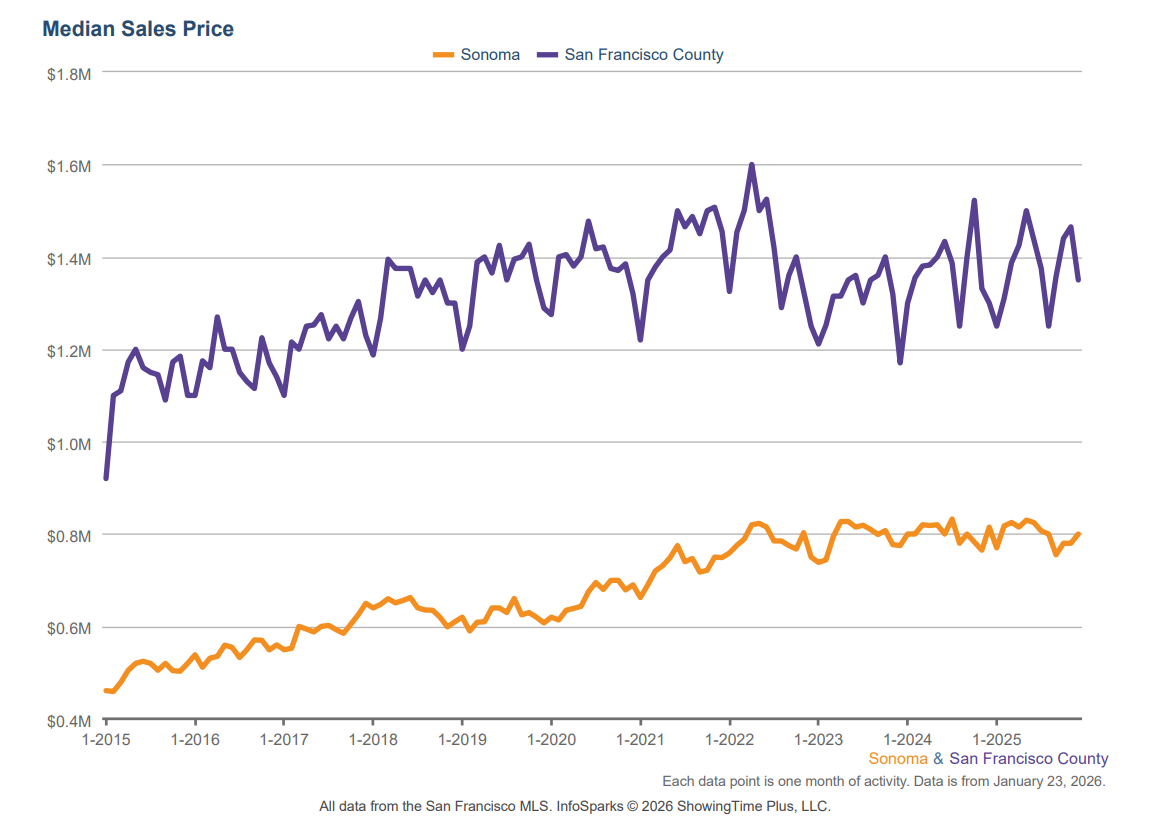
Median Price - Sonoma & San Francisco Counties - Last 10 Years
Early Year: Demand Rises Faster Than Supply
Historically, buyer demand begins rising early in the year, often before inventory fully responds.
From January through late spring, motivated buyers re-enter the market after the holidays. This surge in demand consistently outpaces the number of homes coming to market during the first quarter.
In both Sonoma County and San Francisco, this imbalance is why:
-
Competition among buyers increases
-
Homes tend to sell faster in early spring
-
Sellers often see stronger pricing and cleaner offers
Even in years when the market overall is slower or correcting, spring still produces the highest concentration of serious, qualified buyers. This is why, over multiple market cycles, we see an increase in prices in the first 3-5 months of the year.
Late Spring to Mid-Summer: Inventory Catches Up — and Leverage Shifts
By late spring and early summer, the pattern typically changes.
Seeing strong spring results, more sellers decide to list. Inventory rises — sometimes quickly — while buyer demand begins to level off.
This shift is visible year after year in both markets:
-
Homes take longer to sell
-
Buyers become more selective
-
Pricing becomes more sensitive to condition, location, and presentation
In places like San Francisco, this shift often appears earlier and more sharply. In Sonoma County, it can be more gradual — but the direction is the same.
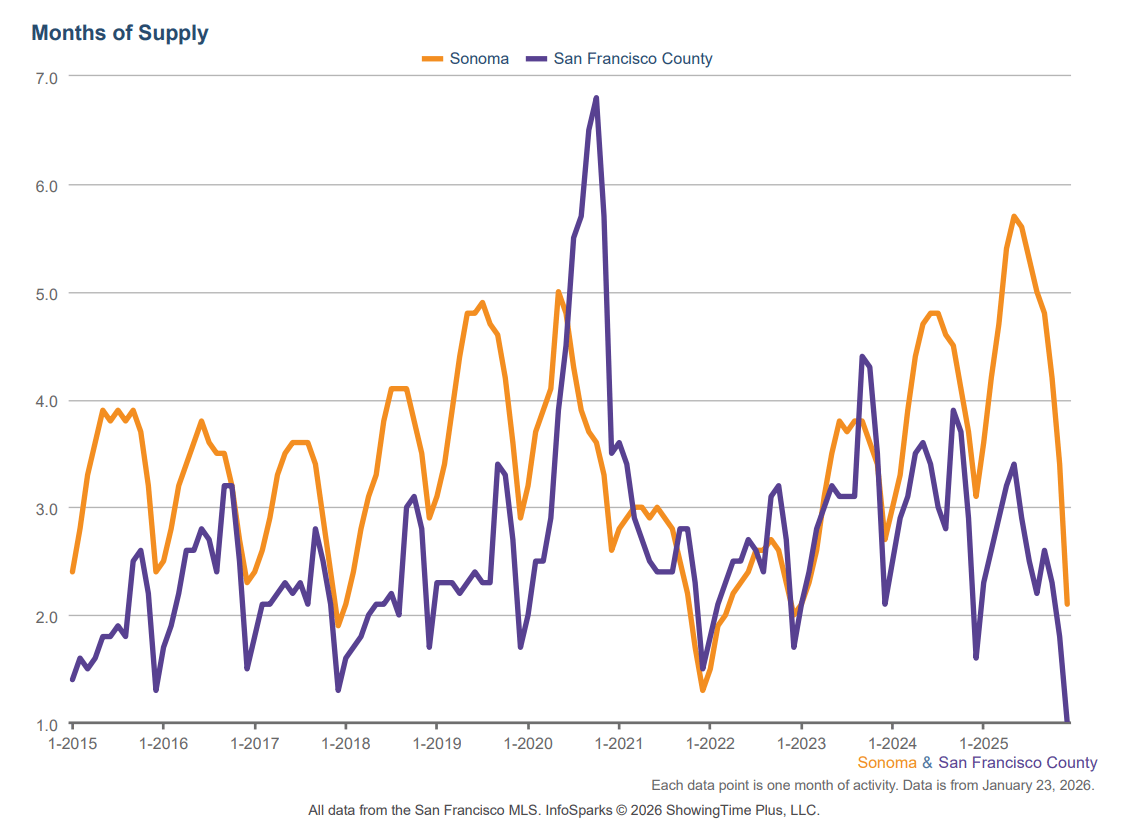
By mid-summer, supply often meets or exceeds demand, reversing the leverage sellers enjoyed earlier in the year. This is when price reductions become more common and negotiation power starts to tilt back toward buyers.
Fall: A Smaller, More Tactical Window
Fall can offer a short second opportunity.
After Labor Day, we often see a surge of inventory, and competition for sellers. Then, as fall advances, inventory usually begins to decline as homes sell through and/or sellers pull listings off the market that have not sold. A smaller but focused buyer pool remains active right up and into the holiday season. Homes that are well-priced and well-presented can still perform well — but pricing is critical to grasp buyer attention and excitement during a very short window of market opportunity.
Winter: Low Inventory, Lower Demand, Mixed Outcomes
Winter is often misunderstood.
From a pure supply standpoint, winter creates some of the lowest inventory levels of the year. In both Sonoma County and San Francisco, fewer homes are listed between November and January, which can benefit sellers simply because there are fewer competing properties.
However, this advantage comes with trade-offs.
Buyer demand also declines in winter. Fewer buyers are actively searching, but those who are still in the market tend to be highly motivated. As a result:
-
Some winter listings sell very well due to scarce inventory
-
Others linger longer because demand is thinner
-
Outcomes are more variable and less consistent
Winter can work, but it’s not as reliable as early spring, when demand is broader and momentum is stronger.
Supply of Inventory - Sonoma & San Francisco Counties - Last 10 Years
The Long-Term Takeaway for Sellers
When you look beyond a single year and study long-term trends, a clear hierarchy emerges:
-
Early spring offers the strongest and most consistent seller advantage
-
Late spring and summer introduce more competition and pricing pressure
-
Winter offers scarcity benefits, but with less dependable demand
The “best” time to list ultimately depends on your goals and personal needs. But if you’re looking for the period where buyer demand most reliably outpaces supply, the data tells the same story year after year:
Earlier is better.
If you'd like to discuss how these trends apply to your specific real estate goals, book a call with me. I’m always happy to walk through the strategy with you.
Email: [email protected]
Phone: (415) 217-9479
Copyright © 2025 Stephanie Johnson. All rights reserved.